Friday, January 25, 2008
Living the Future Conference 2008
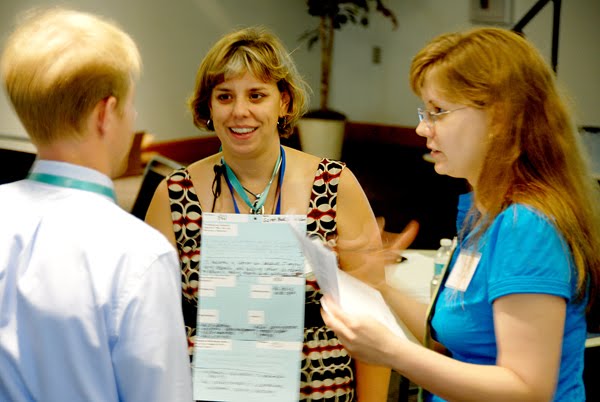
I am happy to announce that CoLAB processes will be used for the first time in a very large group format on day one, May 1st of this outstanding library conference, in Tucson, AZ. Following the keynote address by Peter Senge, Ph.D. and the father of organizational learning, I will facilitate a giant CoLAB session for all conference participants. Our goal is for attendees to connect in a strong way to the available skills and assets available at the conference.
If you've been to a conference and didn't get to REALLY connect with people then you know how important a structured networking session can be. Especially if 150+ people all are interested in the same subject: Transforming Libraries through Collaboration!
To learn more about the conference tracks and presenters, go to www.library.arizona.edu/conference/2008/
Thursday, September 6, 2007
CoLAB in Ontario? Maybe!
I just heard from a librarian at the Carleton University Library who is planning to host a meeting of the Association of University Libarians and is considering presenting the CoLAB networking facilitation method. Leslie Firth attended the train-the-facilitator workshop in Baltimore on how to run a CoLAB session.
Leslie says, "There’s a wealth of expertise and wisdom within this group that
> we would all benefit by sharing." This is why she would rather use time during the meeting for CoLAB conversations: exploring the assets in the room and how they can be connected.
She continues: " I was very impressed by the process when I saw it in action. As well as
> getting people to share, it could be a way to get them to lighten up a bit.
> (Lots more fun than a boring old Oaround the table’.)"
If it happens, I'll be posting the resulting photos on the Collaboration = Creativity = Innovation blog.
Thanks for contacting me, Leslie!
Leslie says, "There’s a wealth of expertise and wisdom within this group that
> we would all benefit by sharing." This is why she would rather use time during the meeting for CoLAB conversations: exploring the assets in the room and how they can be connected.
She continues: " I was very impressed by the process when I saw it in action. As well as
> getting people to share, it could be a way to get them to lighten up a bit.
> (Lots more fun than a boring old Oaround the table’.)"
If it happens, I'll be posting the resulting photos on the Collaboration = Creativity = Innovation blog.
Thanks for contacting me, Leslie!
Future CoLAB Planning Sessions in the works
The University of Arizona Libraries - Science and Engineering Librarians are planning to present a CoLAB session for BIO5 faculty researchers this fall. Librarians have applied for human subjects approval to measure the success of CoLAB's networking process in terms of its effectiveness in eliminating barriers to collaborative thinking and future project ideas. This will provide the first true research results by measuring pre- and post attitudes towards collaborative potential among science faculty who may discover interdisciplinary connections with each other. I'll let you know what happens!
About BIO5: Launched with funds from a voter-approved tax in 2001, BIO5 is designed to fuel economic development by pursuing state-of-the-art biological research, by creating new products and processes, by encouraging productive research interactions between faculty and industrial scientists, by training a bioindustry workforce and enhancing science literacy
Labels:
CoLAB,
Collaboration facilitation,
networking
Sunday, August 5, 2007
Communities of Practice - Origin
" ... small group of people who've worked together over a period of time. Not a team, not a task force, not necessarily an authorized or identified group. They are peers in the execution of "real work." What holds them together is a common sense of purpose and a real need to know what each other knows."
* The term "Community of Practice" was coined by John Seely Brown of the Xerox PARC (Palo Alto Research Center) back in the 1980s.
Communities of Practice Quote
"It is probably true quite generally that in the history of human thinking the most fruitful developments frequently take place at those points where two different lines of thought meet. These lines may have their roots in quite different parts of human culture, in different times or different cultural environments or different religiouse traditions: hence if they actually meet, that is, if they are at least so much related to each other that a real interaction can take place, then one may hope that new and interesting developments may follow." Werner Heisenberg
Labels:
Collaboration,
Communities of Practice
Saturday, August 4, 2007
CoLAB Planning in the Glades
The Glades CoLAB held in Belle Glade, FL was pretty special. It brought participating organizations together that traditionally work in the Glades and those that wanted to extend their services to Glades residents through potential partnerships. CoLAB was so well received because it focused on the assets of organizations rather than gaps. Unfortunately, the Glades communities have been known for what they don't have like a movie theatre. But during our sessions together we mostly focused on what the Glades has to offer, and by combining these assets, determining how goals can be accomplished in new ways.
CoLAB Planning for SDKE: Sonoran Desert Knowledge Exchange

You can't believe how many people and organizations are working on advocating, educating, researching and sustaining the Sonoran Desert in Arizona and Mexico. The University of Arizona Libraries brought some of these folks together to explore the possibilities of connections and leveraging of assets.
It doesn't matter where we live or the subject of our life's work: creating communities of practice is the wave of the future for a variety of reasons. We have more information than ever before, but we are missing the in-person connection that gives us quick real-time information and an indication of mutual interest. If I had all the time in the world, I'd just be interested in interviewing people about their passions, interests, learnings, wisdom, assets, networks, and more. I'm wondering if all of this information is making us more isolated? The conversations are what spark creativity, especially if you have the right people in the room. These are the one's who self-select participation. If they show up, then that's the first step toward discovering the hidden potential in the room and community!
Subscribe to:
Posts (Atom)